Every payment delay has a ripple effect. Goods arrive, services are delivered, but the cash stays locked in payables. As procurement scales, this lag quietly strains working capital, limiting your ability to act on new opportunities or absorb unexpected costs.
Trying to stretch credit terms only goes so far. Push too hard, and you risk damaging supplier relationships. Pay too early, and you tighten your own cash position.
Purchase Invoice Discounting (PID) allows you to pay suppliers on time – sometimes even earlier, without immediately parting with cash. That means smoother vendor relationships, steadier operations, and more control over your capital.
In this guide, we explain how PID works, the models that matter in the Indian context, and how leading corporates are using it to unlock flexibility in their payables.
What is Purchase Invoice Discounting?
Purchase Invoice Discounting is a structured financing arrangement in which a third-party financier pays a company’s supplier on its behalf. The company then reimburses the financier at a later date, typically aligned with the original invoice due date.
This mechanism allows suppliers to receive payments early, without imposing a cash burden on the buyer. Unlike receivables-based financing, which focuses on accelerating incoming payments, PID addresses the outgoing side of the ledger, preserving cash while keeping procurement intact.
PID does not require renegotiation of supplier terms, changes to approval chains, or complex legal restructuring. It works alongside existing procurement practices and is typically managed through a dedicated platform or financing partner.
How Purchase Invoice Discounting Works
- Procurement Initiated: The company places an order with the supplier and receives goods or services along with an invoice, typically on 30–90-day payment terms.
- Invoice Shared with Financier: The company submits the invoice to a financier or a PID platform. This can be done on a per-invoice basis or through an automated batch process.
- Supplier Receives Early Payment: After validating the invoice, the financier typically pays the supplier within a few days. The payment may be for the full invoice amount or a slightly discounted amount, as agreed upon.
- Buyer Repays on Due Date: On the invoice maturity date, the company repays the financier, effectively extending its cash holding period without disrupting supplier timelines.
What makes PID effective is that it allows both buyer and supplier to operate on timelines that suit their financial objectives, without forcing either side to compromise.
What Is the Difference Between Purchase Invoice Discounting and Invoice Factoring?
While both PID and invoice factoring fall under the umbrella of invoice financing, they address entirely different use cases.
| Aspect | Purchase Invoice Discounting | Invoice Factoring |
| Initiated by | Buyer (payer) | Seller (supplier) |
| Based on | Payables (invoices the company must pay) | Receivables (invoices the company is owed) |
| Purpose | Preserve cash while paying suppliers on time | Unlock cash from unpaid customer invoices |
| Who receives funds early | Supplier | Seller (supplier themselves) |
| Who repays the financier | Buyer | Buyer’s customer or seller |
| Relationship visibility | Supplier sees no disruption | Financier may interact directly with customers |
Benefits of Purchase Invoice Discounting
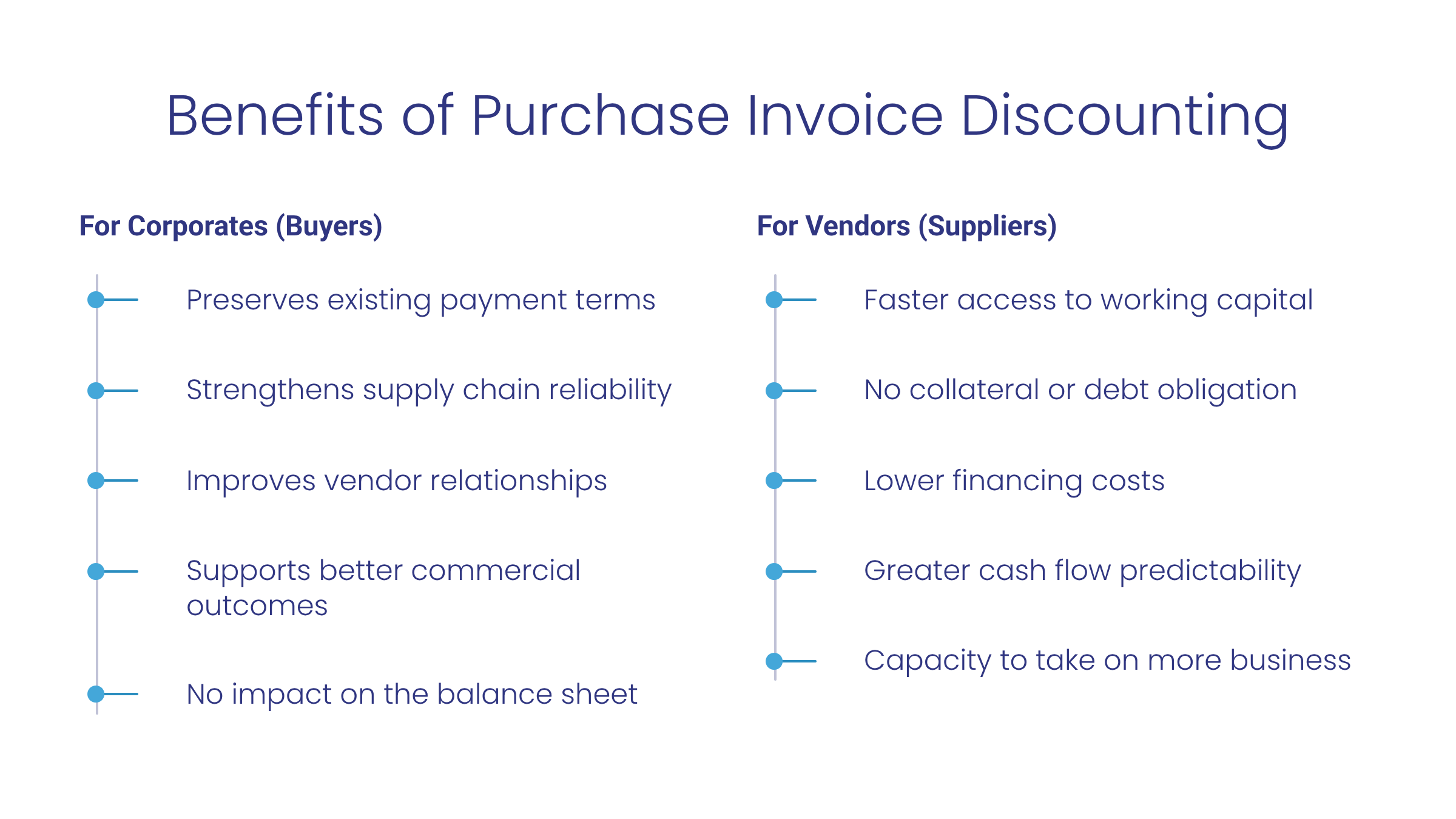
For Corporates (Buyers)
- Preserves existing payment terms: Buyers can retain their standard credit periods while enabling suppliers to access early payments through financing partners.
- Strengthens supply chain reliability: Improved liquidity for vendors reduces the risk of delays, stockouts, or service disruptions, particularly valuable in seasonal or project-driven procurement.
- Improves vendor relationships: Offering faster access to funds can enhance trust and positioning with suppliers, encouraging greater responsiveness and loyalty.
- Supports better commercial outcomes: Early payment options can help buyers negotiate better rates, priority allocation, or improved service levels from their suppliers.
- No impact on the balance sheet: Since the financing is directed to the supplier, buyers do not carry additional liabilities or affect key financial ratios.
For Vendors (Suppliers)
- Faster access to working capital: Once the buyer confirms the invoice, suppliers can receive early payment, typically within 24 to 72 hours
- No collateral or debt obligation: The arrangement is not classified as a loan. Suppliers do not need to pledge assets or record additional debt on their balance sheets.
- Lower financing costs: Financiers price the risk based on the buyer’s creditworthiness, often resulting in more favourable terms for suppliers.
- Greater cash flow predictability: Reliable early payments enable better planning for procurement, payroll, and production cycles.
- Capacity to take on more business: Improved liquidity enables suppliers to accept larger orders, invest in inventory, and manage high-volume or time-sensitive contracts.
Typical Scenarios Where Corporates Benefit from Purchase Invoice Discounting
1. Vendors Unable to Offer Long Credit Terms: Smaller or new vendors often demand quicker payments due to their limited liquidity. PID enables corporates to maintain their preferred credit terms while ensuring vendors are paid promptly, without requiring upfront cash outlays.
2. Large or Urgent Procurement Needs: When faced with high-value or time-sensitive orders, such as those for government contracts, phased projects, or sudden demand spikes, PID allows corporates to fulfill these quickly without diverting internal working capital.
3. Expanding Supplier Base: PID reduces onboarding friction by enabling faster payments to suppliers that may otherwise be hesitant to work on standard credit terms. This helps corporates diversify and strengthen their vendor network.
4. Managing Cash Flow Without Increasing Debt: Instead of tapping into bank lines or internal reserves, corporates can use PID as an off-balance sheet solution to manage payables, preserving liquidity for core operations.
5. Seasonal or Cyclical Procurement Spikes: Industries with seasonal sales cycles, such as agri-inputs, consumer goods, or retail can utilize PID to ensure smooth vendor payments during peak procurement periods without impacting day-to-day cash flow.
6. Leveraging Early Payment for Better Commercial Terms: PID can be used strategically to offer suppliers early payment in exchange for price reductions, bulk discounts, or priority allocation, thereby improving overall procurement efficiency.
Choosing the Right Purchase Invoice Discounting Platform Partner
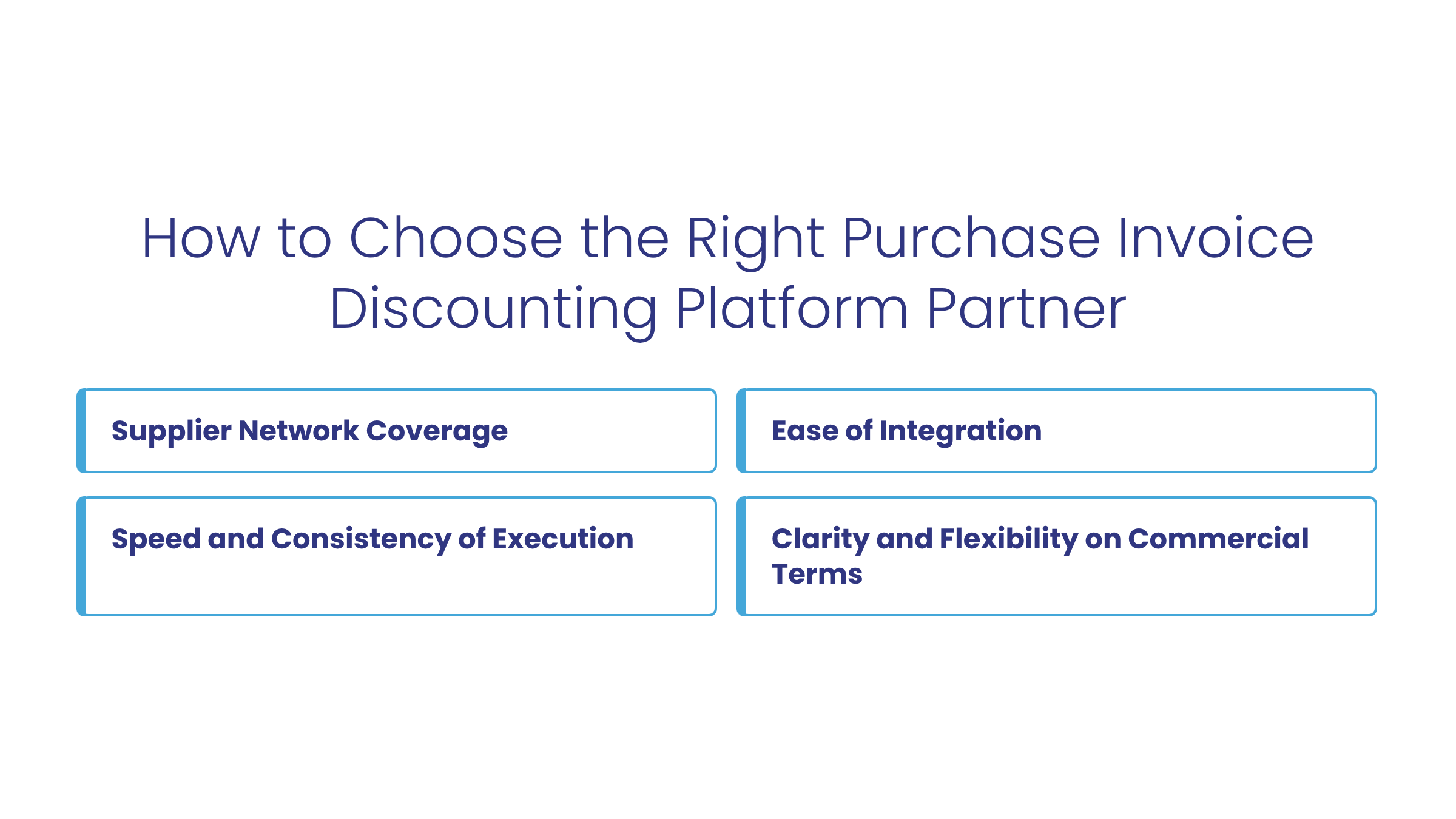
An effective PID program depends not only on financial terms but also on operational fit. When selecting a provider, consider five critical dimensions:
1. Supplier Network Coverage: A strong program should accommodate a wide range of suppliers. Look for a provider capable of working with fragmented or informal vendor bases, especially in emerging markets.
2. Ease of Integration: The PID solution should integrate seamlessly into your existing systems. It should not require changes to supplier contracts, ERP processes, or internal approval flows.
3. Speed and Consistency of Execution: A provider’s ability to process large volumes without compromising turnaround time is essential. This is especially true during peak procurement cycles or when supply chain pressure is high.
4. Clarity and Flexibility on Commercial Terms: Understand who pays the discount: the buyer, the supplier, or a shared arrangement. A good partner will be transparent about fees and provide pricing structures that evolve in line with transaction volume and risk profile.
5. Supplier Support and Communication: Smooth onboarding, documentation assistance, and reliable payment timelines for suppliers can make or break the adoption process. A program that works well on paper but frustrates vendors will fail to scale.
The Role of Technology in Enabling Purchase Invoice Discounting
The complexity of coordinating between buyers, suppliers, and financiers can make traditional PID programs slow and inefficient. This is where technology plays a central role.
Key Capabilities of a Tech-Enabled PID Platform
- Real-Time Invoice Processing: Electronic submission and validation accelerate the discounting cycle.
- Automated Supplier Onboarding: Digitized KYC and simplified registration help expand supplier coverage with minimal effort.
- ERP and System Integration: Seamless data flow ensures accuracy and eliminates manual duplication.
- Dashboards for Cash Flow Visibility: Real-time reporting tools give finance teams transparency into repayment schedules and funding usage.
- Compliance and Audit Readiness: Automated logs, permissioned access, and document trails support internal and external audits.
- Scalable Infrastructure: As supplier networks grow, the platform must maintain consistency in operations and risk checks.
Conclusion: Embedding Purchase Invoice Discounting into Your Payables Strategy
Accounts payable holds untapped potential to improve liquidity and strengthen supplier relationships. Purchase Invoice Discounting enables companies to manage payment timing more strategically, freeing up working capital without delaying supplier payments. When integrated into procurement workflows, it supports growth without disrupting operations or renegotiating terms.
However, the benefits depend on how seamlessly the solution fits into existing systems. Tools that work in silos, require large-scale process changes, or restrict supplier participation often struggle to scale. The more practical approach complements your current procurement setup, supports a diverse supplier base, and offers clarity around pricing and timelines.
Loan Frame’s PID solution seamlessly integrates with your existing procurement and ERP systems, requiring minimal change management. Suppliers receive early payments directly from a curated network of top Indian banks and NBFCs, allowing corporates to responsibly extend payment terms without affecting supplier cash flows.
The platform supports ticket sizes from ₹10 lakh to ₹10 crore and invoice maturities up to 180 days. With real-time tracking, transparent pricing, and same-day disbursements, it’s designed for both ease and scale.
Book a call to explore how PID can support your capital strategy.